Silicon's cousin,
built for extremes.
ADAMAS asks what it takes to build chips on diamond wafers instead of silicon: kilovolt power switches, logic that runs at 400 °C, and qubits that work at room temperature. Every number here comes from a cited equation or measurement, and every lab runs the same physics as the Python package.
Or press Ctrl K to search every lab, term, figure, experiment, and process step.
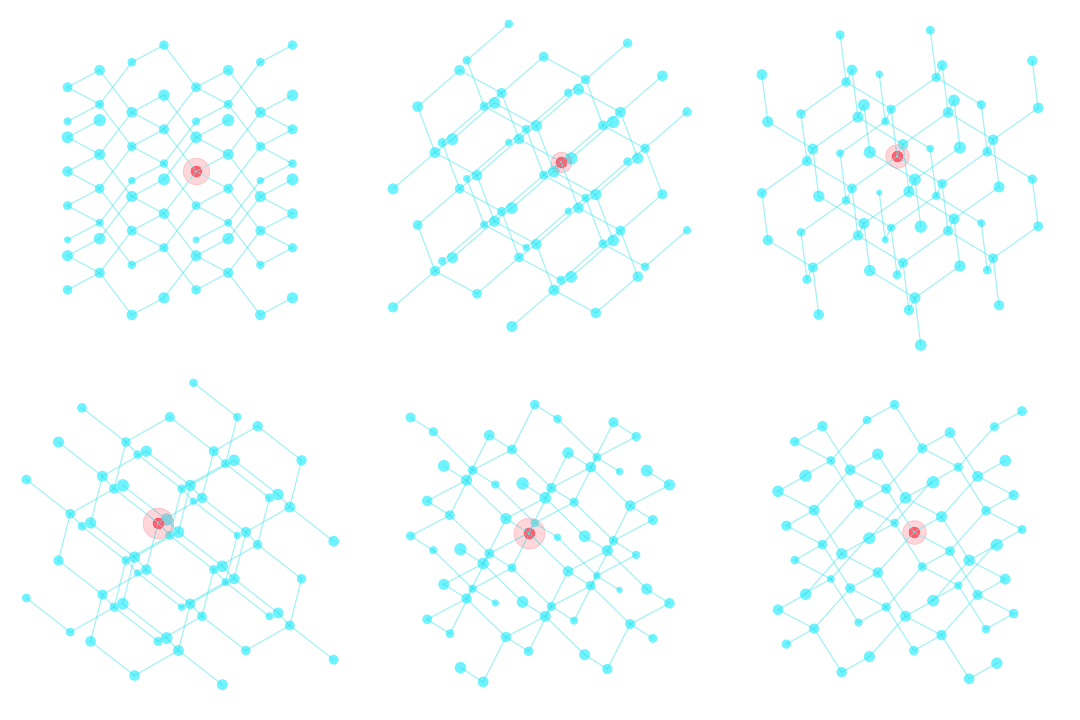
Drag the crystal. The red atom is nitrogen; the dashed sphere beside it is a missing carbon. Together they are the qubit.
Five results, computed, not quoted
Each number below is generated by the Python package from cited inputs and checked by the test suite; the preprint uses the same values.
Diamond's ideal power-switch figure of merit relative to silicon.
Median loss advantage over silicon carbide in an EV inverter once material uncertainty is included (× to ×). How we know →
Two-qubit fidelity that coherence alone would allow; the measured 0.67 means the charge state was ready only of the time.
Threshold of the native XZZX code under strongly biased noise, against % for the standard code.
Validation checks passed against published results, independent tools, and known answers, over references.
Where should you start?
Just curious
Why anyone would try this
Same crystal pattern. Very different numbers.
Silicon and diamond share the "diamond cubic" lattice. Diamond's atoms are smaller and bonded far more tightly, which changes almost everything. Pick a property.
Paint with heat. Watch it escape.
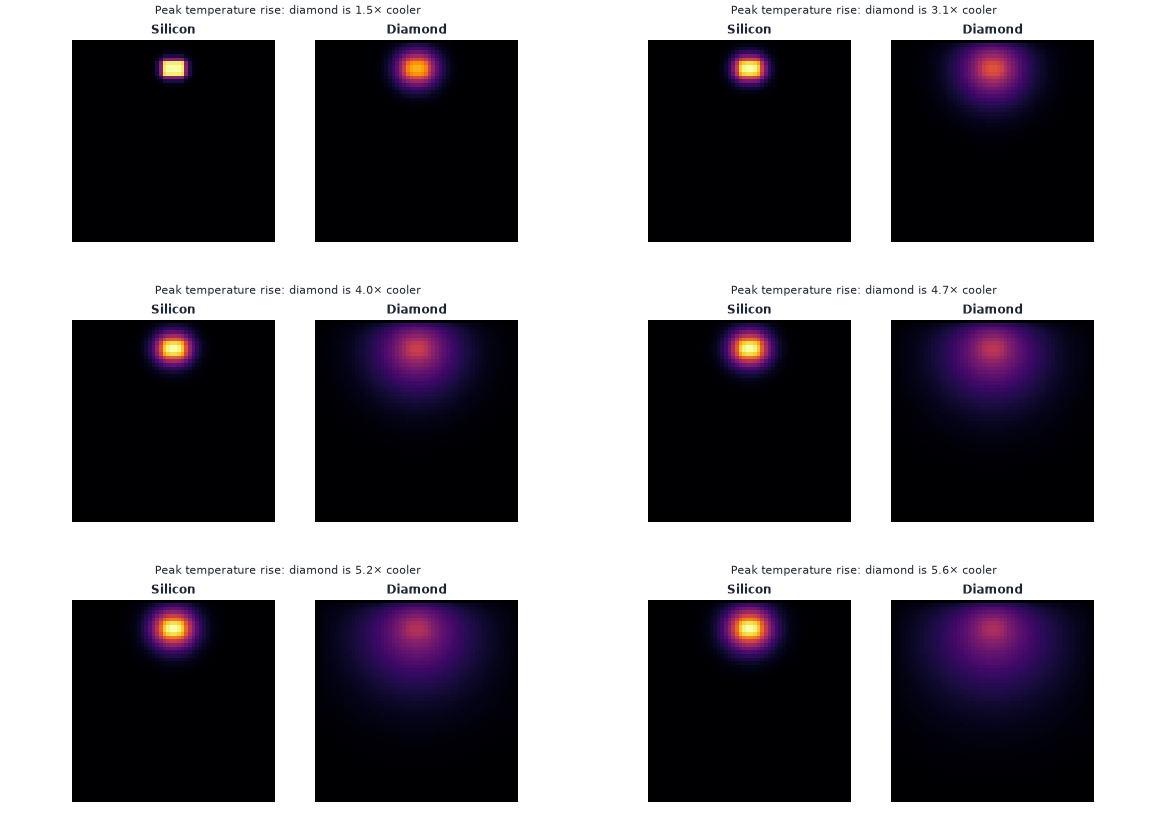
Move your cursor across the slab. The left half is silicon, the right half diamond: same grid, same time step, same heat. Diamond's heat spreads about 13 times faster, which is why a diamond chip runs cool.
Thermal diffusivity α = κ/(ρc). Sources: [glassbrenner1964] [wei1993]. The full four-material simulation is in the Heat Race.
From a gas to a quantum computer, in eight steps
The models, in motion
Every animation is drawn by the same code that makes the figures. See all 46 in the gallery →
Don't read it. Run it.
Thirteen hands-on simulations and explorations. Each explains itself at three reading levels, from "I am 10" to "researcher", and lists its sources.
Qubit Lab
Fire microwave pulses at a room-temperature spin on a 3-D Bloch sphere. Watch Rabi, Ramsey, and spin-echo happen, and see why an echo rescues a dephased ensemble.
Enter → PowerHeat Race
The same hot transistor on silicon, silicon carbide, gallium nitride, and diamond, solved live with the heat equation. Diamond runs about 15× cooler.
Enter → MaterialsLattice Lab
Fly through silicon and diamond at the same scale, drop in an NV center, and point a magnet to split its resonance lines.
Enter → LogicDiamond CPU
Program DIA-4, the 4-bit processor synthesized onto diamond transistors in this repo. The emulator matches the Verilog cycle for cycle.
Enter → Error correctionBreak the Code
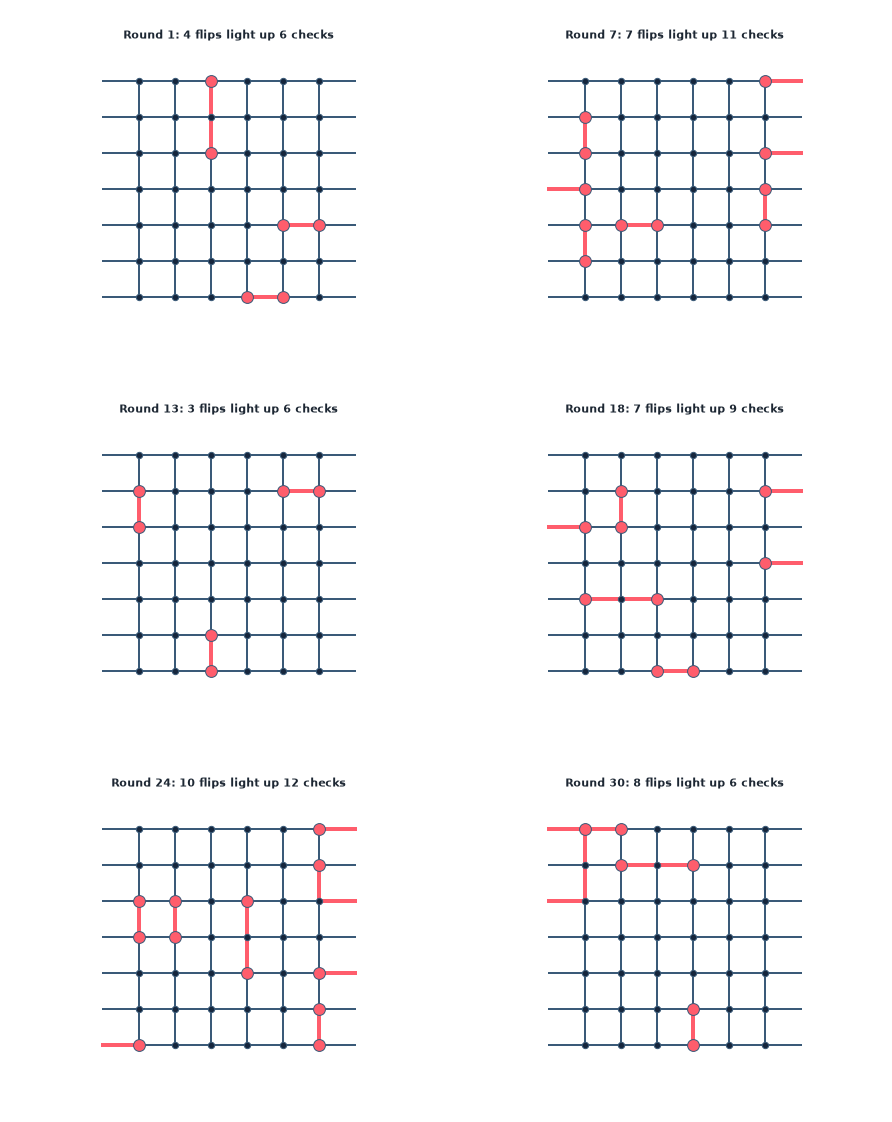
Click qubits to inject errors into a surface code. Watch the syndrome light up and the decoder fight back, until it can't.
Enter → ProcessFab Walkthrough
Build a hydrogen-terminated diamond transistor layer by layer, the way a cleanroom would, and see exactly where silicon's recipe breaks.
Enter → DevicesTransistor Lab
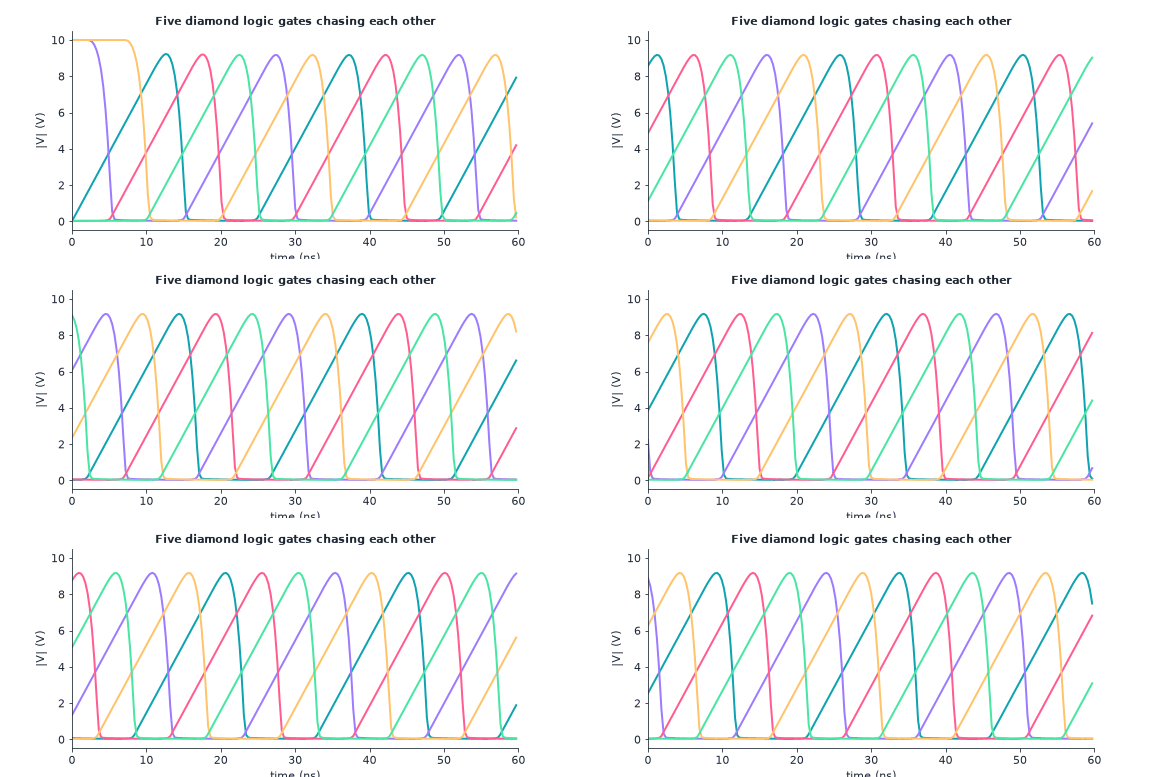
Tune a diamond transistor and watch its I–V curves, a logic gate's transfer curve, and a five-gate ring oscillator respond. Checked against SPICE.
Enter → PowerPower Lab
An electric-car inverter on silicon, SiC, GaN, and diamond: switch loss, die size, heat-sink size, and what happens at 300 °C.
Enter → ArchitectureMachine Builder
Size a room-temperature diamond quantum computer for a real job, from circuit-level error-correction simulations: code distance, millions of qubits, die size, and a runtime you can shrink by speeding up readout.
Enter → QuantumPhoton Lab
Watch one NV center absorb green light and emit red photons, jump by jump, and see the dark detour that lets light read a spin.
Enter → ManufacturingWafer Lab
Rain random defects onto a 3-inch diamond or a 300 mm silicon wafer and count the chips that survive. Small dies win.
Enter → ArchitectureThe Chip Stack
Scroll to explode the five-layer quantum processor this framework proposes, from silicon controller to diamond qubits to the light that resets them.
Enter → LandscapeWho is building it
A 3-D globe of the labs and companies behind every result here, each point cited and labeled peer-reviewed, news, or vendor claim.
Enter → All equationsExplorer
Nine live panels and a guided tour through the whole framework.
Enter →From a model to a measurement
The traveler tells a cleanroom how to make the devices, the experiments say what to measure for US$100 and up, the Data Lab fits what you measured, and the Confidence page shows how sure each number is.
Experiments in 3-D: from a US$150 kitchen-table kit to a pilot line
Ten experiments in four budgets, each drawn as a 3-D apparatus you can orbit. Click a step and its parts light up; parts lists carry approximate prices; the plot shows what a working setup should measure.
Open the experiments → AnalysisData Lab: fit your own measurements
Drop a CSV from any experiment (ODMR, Rabi, Ramsey, echo, Arrhenius, transistor, photon correlation) and watch the fit converge step by step, with uncertainties, residuals, and what the numbers mean physically.
Open the Data Lab → Process engineeringProcess Traveler: build the chip, step by step
Nineteen cleanroom steps from a bare diamond plate to a tested chip: animated cross-sections, starting-point parameters with sources, checks with pass windows, safety, failure modes, five product variants, and a run log you can export to CSV.
Open the traveler → RigorConfidence
The validation matrix and a live Monte Carlo: how much to trust each headline number, and which unknown matters most.
Check it →Read it, present it, print it
Preprint
The framework's results with sources, uncertainty, and limitations. Every number is generated by the code.
⬇ Download PDF · 12 slidesTalk
A 12 to 15 minute seminar or interview talk, with speaker notes in docs/TALK_NOTES.md.
⬇ Download PDF · A0 posterPoster
Conference poster with a QR code to this site. Prints at A0 (841 × 1189 mm) or scales to 36 × 48 in.
⬇ DownloadWhat is still hard
Deep dopants
Under 1% of boron atoms are active at room temperature, against 90% in silicon.
76 mm, not 300
Reproducible 3-inch single-crystal wafers arrived in 2026. Silicon has used 300 mm for decades.
No easy CMOS
The first n-channel diamond MOSFET is from 2024, so logic is still p-channel only and burns static power.
Placement and charge
Two qubits must sit within about 25 nm, and each is in the right charge state only about 75% of the time.